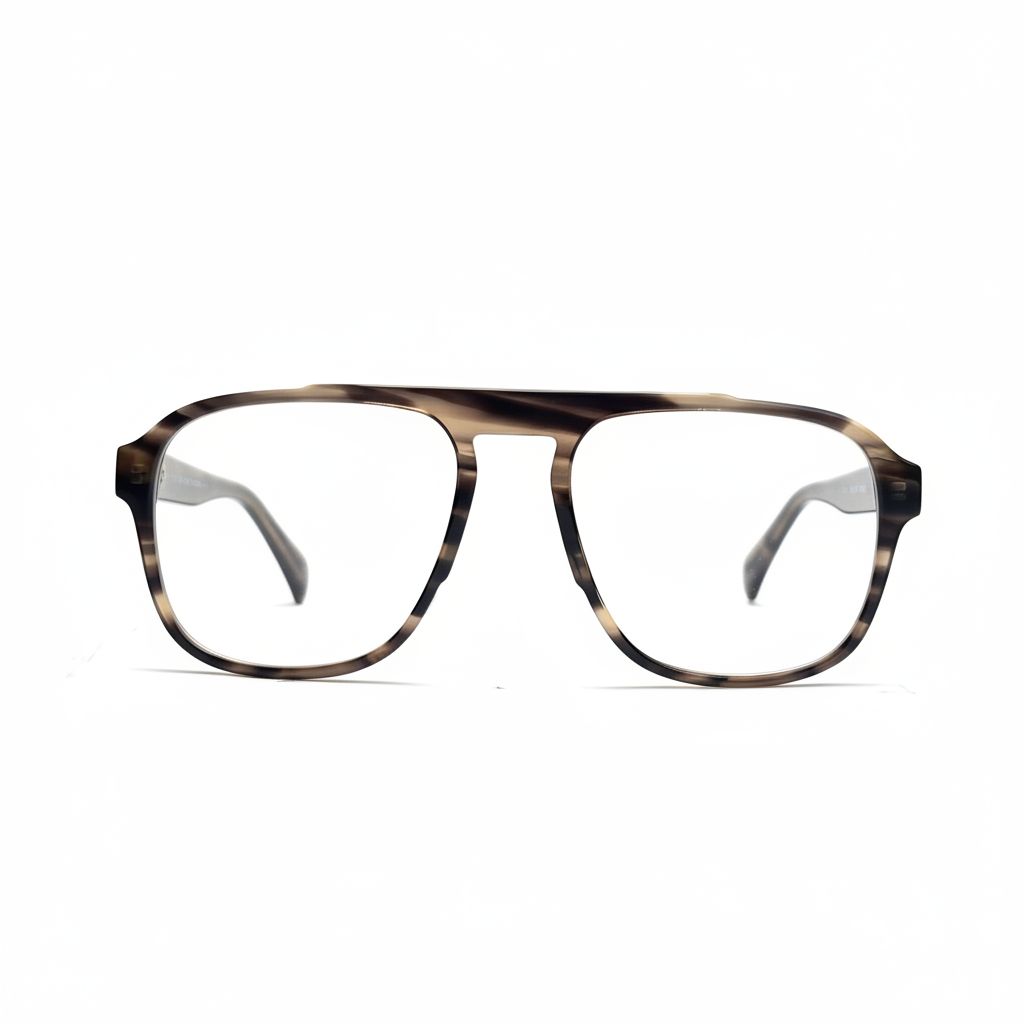
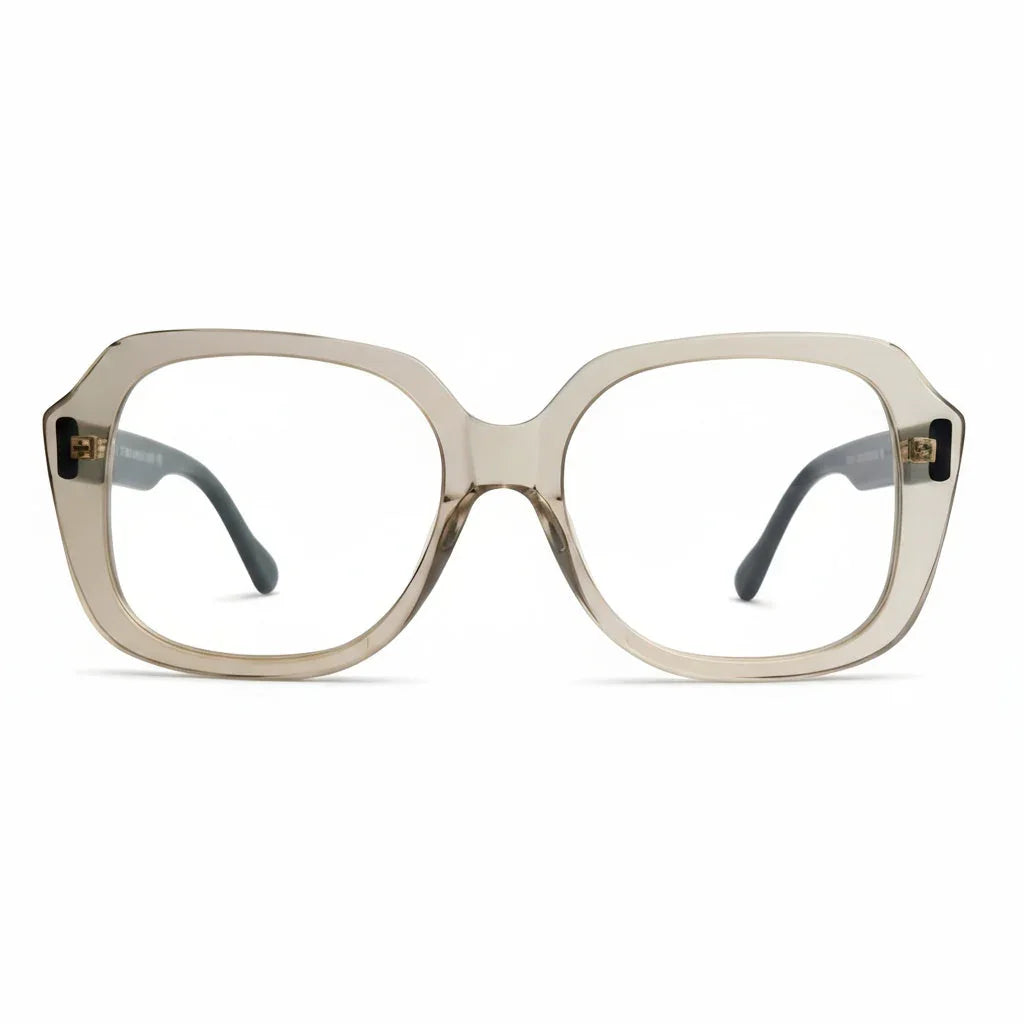
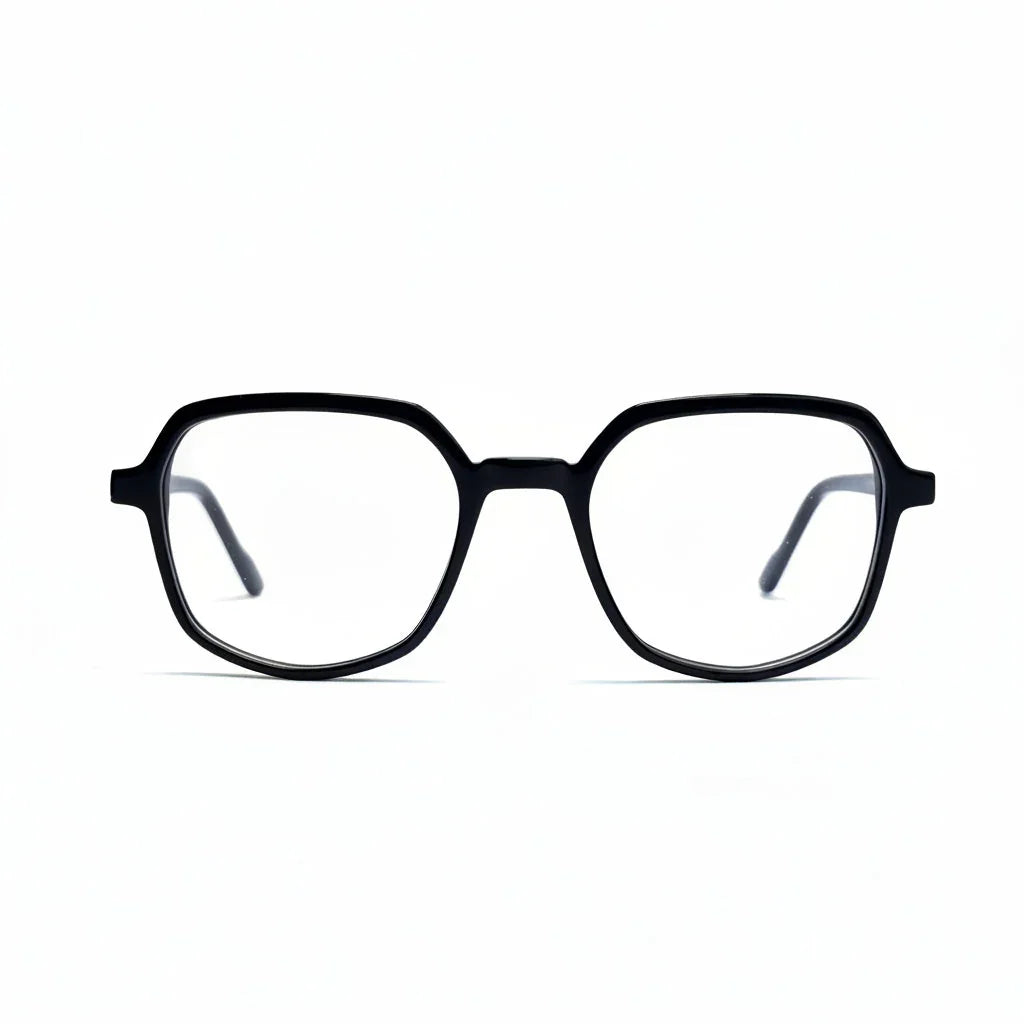
Every couple of weeks the same question lands in an eyewear forum: someone has been told their glasses look boring and wants to know which shape to switch to. The replies list cat-eye, aviator, geometric, clear frames — a different outline for every answer. Almost nobody mentions the two things that actually change how a pair reads: how large the front is, and how much colour weight it carries.
That is the most useful way to read glasses trends 2026. The shapes on the shelf are roughly the same as two years ago; what moved is scale and colour weight.
The Two Variables Nobody Adjusts
A 50 mm round and a 56 mm round are not the same frame in a smaller size. One sits inside the face like spectacles, the other sits across it like a piece of design.
The same is true of colour weight — how strongly the rim registers against hair, brow and skin. An opaque black frame and a translucent honey frame from the same mould do not read as siblings: one draws a hard line, the other reads as a tint of the face.
Shape gets the attention because it is easy to name. Scale is a number nobody photographs.
The 2026 Shift: One Step Up, Not Oversized
Across this year's collections, the medium frame has been quietly replaced by the medium-large one. Where a 48–50 mm lens once read as normal, 50–53 mm now does. This is not the oversized movement of a few seasons ago — oversized is a frame that floats past the temples. This is one step up, with the rim kept thin so the pair gains presence without gaining bulk.
Two things pushed it: tailoring loosened, so a small precise frame no longer matches the clothes it sits above; and we now mostly see each other cropped at the shoulders on a screen, which makes the frame proportionally smaller in the picture than in the room.
How to Read Frame Scale in Millimetres
You do not need a fitting to work this out. Your current pair has the numbers stamped inside one temple, in the format 52 □ 18 – 145: lens width, bridge, temple length. Add twice the lens width to the bridge and you have a working estimate of the front's width.
Compare that to your face width at the temples — within two or three millimetres either way is normal. To move a pair from correct to current, go up two or three millimetres in front width and down in rim thickness, so the face keeps its proportions. Consider the Arno square titanium frame — a square silhouette on a fine titanium rim, so it reads larger without reading heavier, which is the trick 2026 keeps asking for.
Colour Weight: Why Black Can Read as Flat
Think of colour weight in three tiers. Opaque, saturated frames carry the most: they draw a graphic outline and hold the eye. Translucent and tortoiseshell frames sit in the middle, letting light through so the edge softens. Thin metal frames carry the least — they mark the shape without filling it in.
Boring almost always means the frame sits at the same value as what surrounds it: a dark frame against dark hair and a strong brow merges into one mass, and a mid-tone vanishes against light hair. The fix is not a louder colour but one step of separation — warm tortoise or honey against cool black hair, deep olive or smoke against blond.
The Egon round premium acetate frame shows medium colour weight doing the work: deep enough to hold a shape, warm enough that it does not cut a hard line across the face. For the opposite approach, the Ditlev geometric acetate frame builds its presence into the silhouette instead. And an acetate front with titanium detailing gives two weights in one object, like the Colin titanium-mix square frame.
Are Round Glasses Still Modern in 2026?
Yes — with caveats, which is why people try a round frame and conclude round does not suit them. Round works when lens depth is generous and the rim is fine: a medium-large lens in thin metal or translucent acetate reads as current, almost architectural. It stops working when it is small, perfectly circular and cut from thick opaque acetate — that combination belongs to a costume, not a wardrobe.
The middle ground is the panto: round at the bottom, slightly flatter across the top, which gives the brow a line to sit on. In sunglasses the same logic applies with more room to play — a translucent round acetate front, like the Breezy round acetate sunglasses, carries scale through the material rather than a heavy rim.
Glasses Trends 2026 for Women Over 50
This question sits behind a lot of 2026 eyeglasses trends searches, and the honest answer is that the rules barely change — the numbers do. Hair colour usually shifts a step or two over the years and skin tone often warms or pales, so a frame that matched at 35 can now sit too close in value. Four adjustments cover most of it:
- Go up, not down, in scale. A slightly larger front with a thinner rim reads more current than a small, neat frame, which tends to date a face.
- Set the top line at the brow. The upper rim should follow the brow, not sit well below it.
- Choose warmth deliberately. Warm metals and translucent acetates pick up the warmth in most complexions; bright silver against a cool, pale palette can read cold.
- Drop the heavy bottom rim. A thick lower edge adds weight downward; a fine lower rim, or semi-rimless construction, keeps the balance level.
A Five-Minute Test Before You Commit
Four checks, all doable at home:
- Photograph from 1.5 metres in daylight. Selfie distance distorts the front width; the further back the camera, the truer the read.
- Check the brow line. If the top rim sits more than a few millimetres below your brow, the frame is too small for the face it is on.
- Look at the temple-to-cheek gap. A visible gap on both sides means the front is narrow; contact at the cheek means it is too wide.
- Hold the frame against your usual collar. If the neckline you wear most days is a soft knit and the frame is a hard black rectangle, that is a colour-weight problem, not a shape problem.
None of this requires replacing a shape you already like. The pair that gets called boring is usually a good silhouette one size too small and one value too close to the person wearing it.