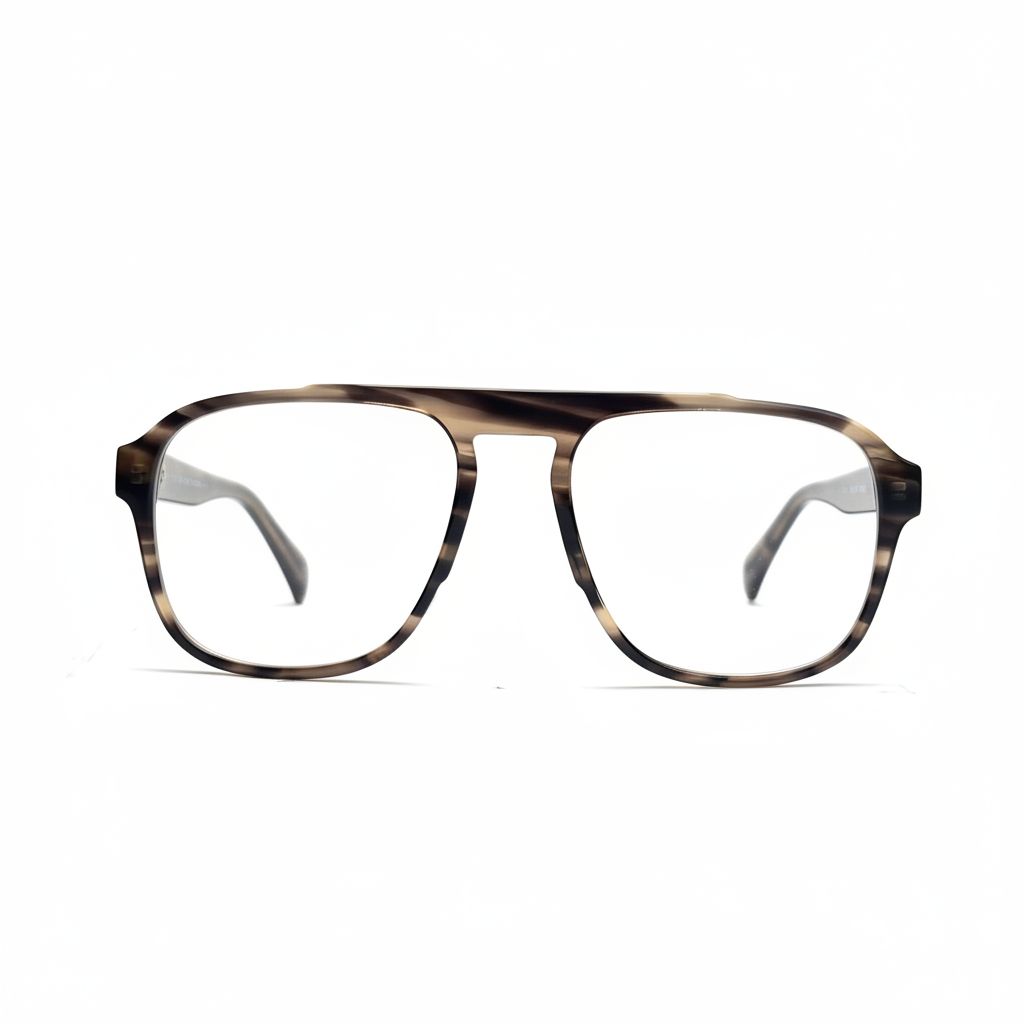
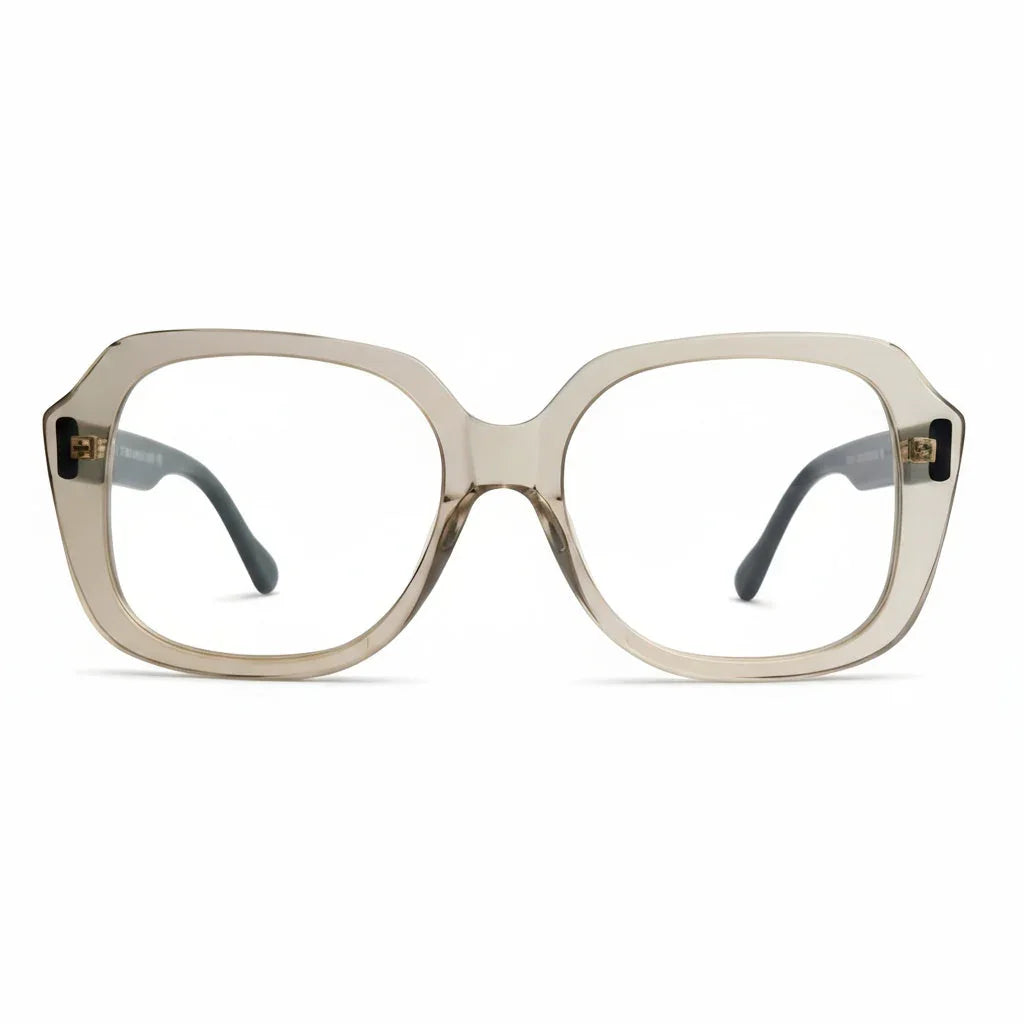
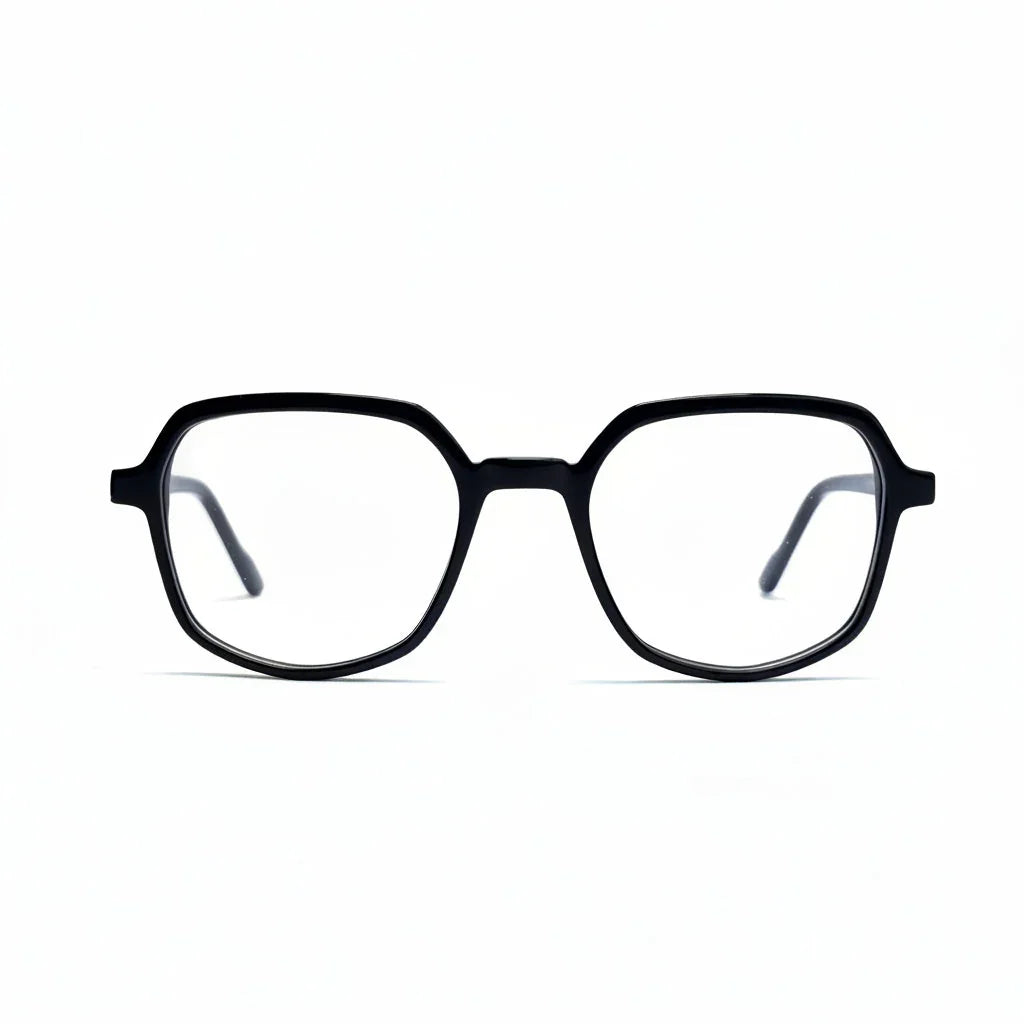
Every so often a pair of glasses develops a whitish film across the front. It looks like dust that won’t wipe away. Run the frame under a tap and the film disappears — then creeps back as the frame dries.
That detail is the most useful clue about how a frame was made. Eyewear wearers on Reddit have been comparing notes on exactly this: one thread last August described frames “developing this whitish haze” that clear under water, while another poster held an old pair up to a window and found the surface no longer looked like ordinary wear.
Neither pair “went bad”. Both had a surface — a finish or a coating — doing the only thing surfaces can do over years of handling. Which is why the most durable choice in eyewear is rarely the frame marketed as durable. It is the frame whose colour was never a separate layer.
Where the colour actually lives
Two ways to put colour on a pair of glasses, and they behave differently for the life of the frame.
Colour through the material. Acetate arrives at the factory as solid sheet, with the pigment or pattern fused in during manufacture. The frame front is cut and milled out of it, then tumbled and polished. Every surface you can see, including the cut edge, is the same material all the way through.
Colour on top of the material. Injection-moulded frames — polycarbonate is the most common — are formed in a base colour, then finished with a lacquer layer that supplies the final colour and gloss. Fast, precise and inexpensive; the colour, though, is a coating sitting on a substrate.
Most of what people are really asking when they compare acetate vs polycarbonate frames comes down to this distinction without anyone naming it: is the colour the material, or a layer above it?
Why tortoiseshell can never be printed
The mottled pattern most people call tortoiseshell is made by layering, pressing and fusing sheets of different colours, then slicing the block. The pattern does not stop at the surface: turn the frame over and it is on the inside of the temple too. Even the millimetre-wide bevel around the lens still shows it.
That is why two tortoise frames from different makers can look nothing alike — pattern density, layer count and how warm the base colour runs all change the read. A frame like the Egon premium acetate round depends on that layering; the depth you see is structural, not decorative.
On a painted frame the test fails politely: the edge is a uniform base colour, sometimes with a visible hairline where the paint stops.
The white haze, explained as a product problem
When a haze disappears under water and returns as the frame dries, you are looking at a surface, not a material. Two common causes:
- Lacquer breakdown. On painted frames, moisture and handling eventually lift the clear top layer at the edges of fine scratches, and the dulled patches read as a film.
- Polishing wear. On acetate, the polished skin can frost slightly where the frame is handled most — usually the temple tips and the top of the front. Unlike a failing coating, this is a surface that can be brought back.
What makes the difference is what you clean with. Solvent wipes — anything alcohol or acetone based — attack lacquer and dull polished acetate in a single pass. Paper towels leave micro-abrasion. Heat is worse: a frame left on a dashboard softens, and acetate that has been re-hardened will not sit the same way again. Lukewarm water, a drop of mild soap, fingertips, then a clean microfibre cloth does the whole job.
The Dagfinn acetate square is built for that routine: solid colour, walls thick enough to survive a decade of wiping, no finish layer to lose.
The 30-second check before you buy
You can settle the question in a shop, or from a good product photo:
- Find the cut edge. The inside bevel around the lens and the very end of the temple tip are where a painted frame gives itself away.
- Follow the pattern. If the mottling appears on the front but the inside of the temple is flat colour, it was applied, not made.
- Look at the wall thickness. Acetate fronts are milled, so they can be chunky and sculpted; injected frames are limited by how the mould fills.
- Check the hinge. Visible screws you can tighten yourself are a service point. An integrated hinge is a sealed unit.
None of this makes polycarbonate a bad material — it is tough, light, and the right call for a frame that gets thrown in a gym bag. It simply means you are buying a finish. Sunglasses make the trade-off obvious, because the front takes the most sun: Astrid cat-eye sunglasses keep their colour in the acetate sheet, where there is nothing to fade off.
What “buy fewer, keep longer” means in practice
Cost per wear is the only number that matters, and it rewards patience. A frame worn daily for two years costs pennies a day. Two cheaper frames that haze within eight months cost more, and you own neither at the end.
The practical version is a rotation of two pairs rather than a drawer of six: each takes half the handling. Temples get re-bent instead of replaced; hinges get tightened instead of abandoned.
This is the thinking behind a deliberately small range at WEISS OPTIX — solid-colour acetate and titanium, not several hundred seasonal SKUs. Fewer shapes means each gets chosen properly, and a colour that stays in range is one you can still fit a lens to in three years. The Eamon square acetate is the everyday version: one shape, one colour, nothing on it that can wear off.
Honest caveat: solid-colour acetate is not automatically the greener option, and no frame is beyond replacement. What it does is survive repolishing and re-fitting — usually the difference between a five-year pair and a two-year pair.
Where metal changes the equation
Titanium does not carry colour the same way. It is finished by anodising, ion plating or a physical vapour coating — thin, hard, and bonded to the metal rather than sitting on it. That is why the Anton titanium-mix square pairs an acetate front with titanium temples: the front carries its colour in the sheet, the arms carry theirs in the metal.
It is also why the two materials age differently. Acetate softens slightly and takes the shape of the wearer; titanium does not move at all, so it either still fits or it never did.
Five habits that add years
- Store frames folded in a case, not loose in a bag.
- Rinse before wiping — grit on a dry lens is what scratches it.
- Keep frames out of hot cars and off radiators.
- Tighten hinge screws twice a year with a jeweller’s driver.
- Ask for a temple re-bend before you consider a new pair.
A frame that keeps its colour does not need replacing to look current. It just needs looking after — a far shorter shopping list than starting over every season.