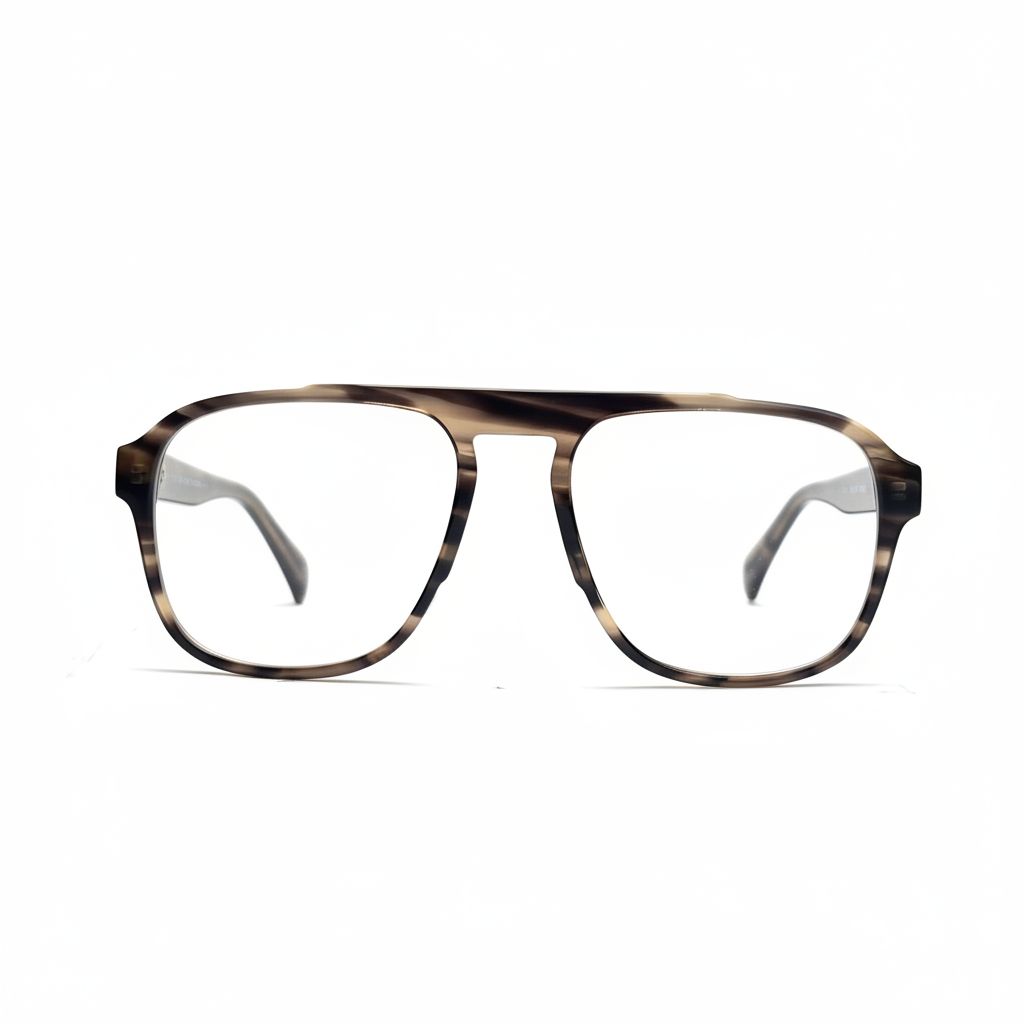
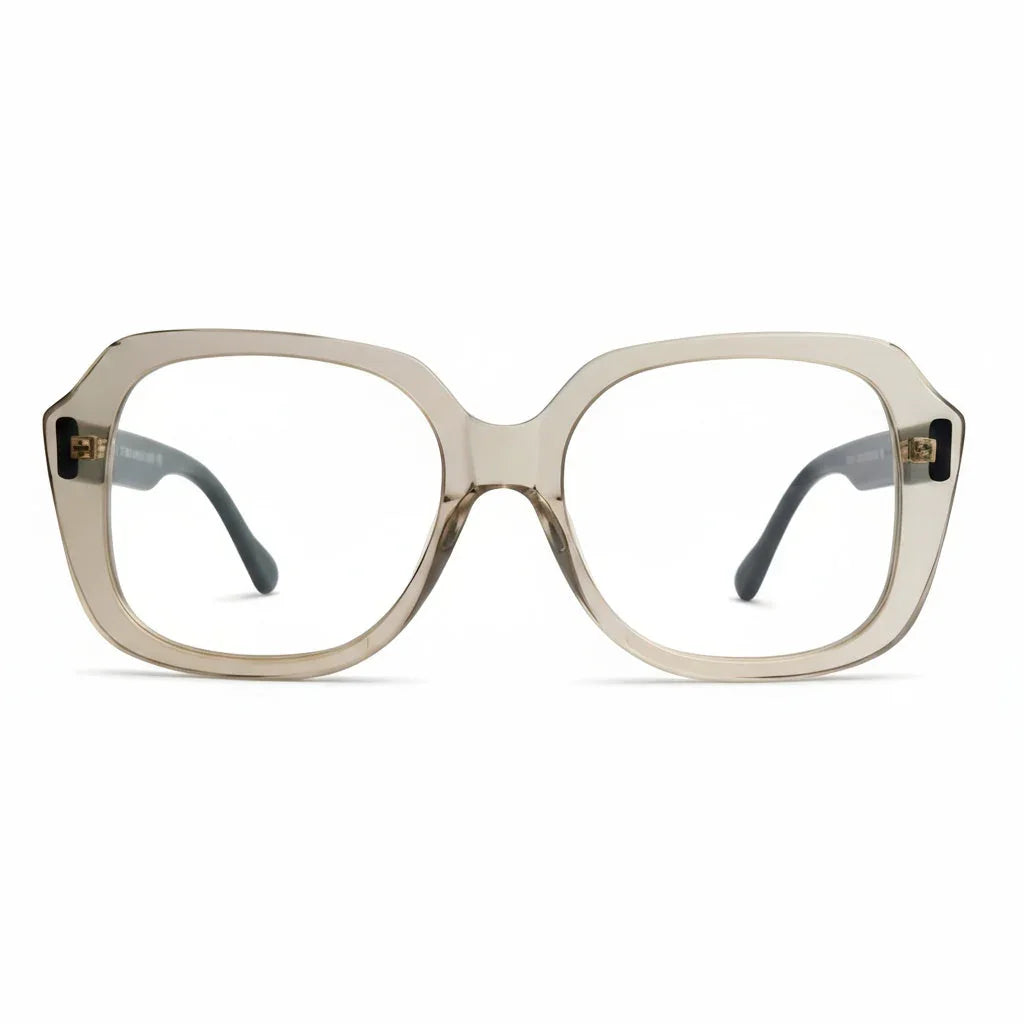
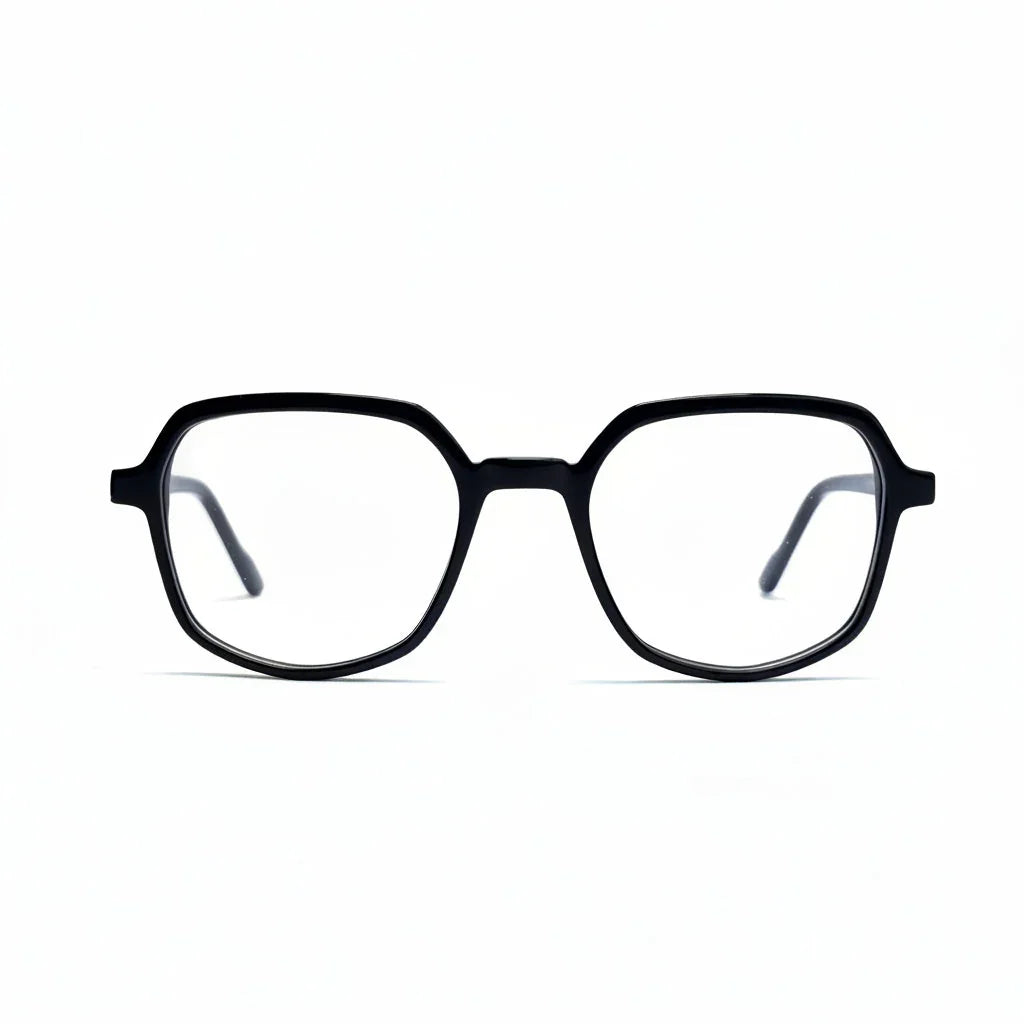
There is a post on r/eyewear that has stayed with us. A reader had worn the same designer pair for five years — around 900 US dollars with lenses — and had loved them. Then the hinges started to crack. Not the acetate front. Not the titanium temple. The place where the two meet.
That story is both the best argument for hybrid construction and the best warning about it. An acetate-titanium frame can be the most balanced pair you own, or an expensive compromise, and the difference is almost entirely in the joint.
Acetate-Titanium Frames: What "Hybrid" Actually Means
Hybrid is not one construction. It is at least three, and they behave differently.
- Acetate front, titanium temples. The most common form. Acetate's colour and silhouette where you look at it, metal where the frame carries weight.
- Titanium front, acetate temples. Rarer, and mostly a styling choice — a technical front with a warmer, thicker rear.
- Semi-rimless hybrid. An acetate brow with a titanium wire carrying the lens along the bottom.
Most people searching "acetate vs titanium glasses" assume it is either/or. Hybrid is the third answer — and it is the construction we build most of.
Consider the Andre round acetate-titanium — a round acetate front with titanium detailing, the version of hybrid that reads most like a classic frame at a glance.
Acetate vs Titanium Glasses: What Each Material Is Good At
Neither is better. They are good at different things.
Acetate is a plant-based sheet material, cut and milled rather than moulded. Colour runs all the way through the sheet, so a tortoiseshell frame cannot chip to a different colour underneath. It takes a deep polish, holds a bold silhouette, and carries its mass in the front.
Titanium is roughly 40% lighter than acetate at the same strength, corrosion-resistant, and holds fine sections without going out of shape. Colour is applied — plated or anodised — rather than being part of the material, which is why metal frames live in a narrower palette.
One clarification that lands in our inbox constantly: polycarbonate is a lens material, not a frame material. "Polycarbonate vs acetate frames" is really a question about the lens inside the frame — we covered it in our acetate vs polycarbonate guide. Today is about what happens when acetate and titanium work together.
The Joint Is the Part Nobody Photographs
Every hybrid has an endpiece: the small block at the outer corner of the front where the temple attaches. On an acetate front, that endpiece is acetate. The hinge inside it is metal. Two materials, one drilled hole, a lifetime of load.
Three joints, three lifespans
- Riveted through the acetate. Most secure when new, with visible pin heads on the front. Not adjustable — once the acetate around the pin crazes, there is nothing left to tighten.
- Screwed into a metal insert. The insert is embedded in the acetate during assembly. More costly to build, far more serviceable: the screw is a replaceable part.
- Barrel or spring hinge in the temple. Common on titanium temples. The spring lets the temple flex outward instead of stressing the endpiece — until the spring itself gives.
That Reddit failure — cracking after five good years — is usually acetate giving up around the hinge fixing rather than metal failing. Which is why the grade and thickness of acetate at the endpiece tells you more than the name on the temple.
Consider the Carsten round hybrid — a round acetate front with titanium temples, where the endpiece stays deliberately compact so there is less acetate to flex around the hinge.
Front Weight Versus Back Weight
This is the part you feel rather than see. In a full acetate frame, nearly all the mass sits in the front and two acetate temples have to hold it. In an all-titanium frame the weight is thin and even end to end. A hybrid splits it: acetate's presence at the front, the rear two-thirds in a material roughly 40% lighter.
The result is front-weighted but not heavy — you carry the acetate only where it is visible. It changes behaviour too: a front-heavy pair tips forward when you look down, a balanced pair stays put. If a pair slides down every time you read, front weight is usually why.
Consider the Baptiste square hybrid — a square acetate front on titanium temples, the construction that benefits most because a square front is the heaviest silhouette to begin with.
How to Check a Hybrid Joint in Fifteen Seconds
You can assess the weakest point of any hybrid before you buy, and again the day it arrives.
- Hold the front, open one temple. It should move smoothly, no click, no wobble at the endpiece.
- Look where the metal enters the acetate. A clean, tight line is correct. A visible gap or a fine pale stress line means it has already been flexed.
- Press the temple tip gently toward the front. Both sides should resist evenly. If one gives, the hinges are set at different angles.
- Find the screws. A single loose one is the most common cause of a crooked temple — and the easiest thing in eyewear to fix.
- Fold both temples and set the frame down. Both tips should touch. If one floats, the frame is twisted at the bridge, not the joints.
Living With a Hybrid Frame
- Do not soak it. Acetate absorbs a little water and swells; the metal inside it does not. Wipe the frame, do not dunk it.
- Take it off with two hands. The one-handed pull levers the temple at exactly the axis the hinge is weakest on, and accounts for most hinge play we see.
- Store it folded, in a case. A hybrid left open puts its whole weight on one endpiece overnight.
- Remember which half responds to heat. Acetate eases with gentle warmth; titanium does not. A temple bend is a metal adjustment.
- Service the screws, not the materials. A small screwdriver and thirty seconds once a year outlasts most repairs.
Consider the Andreau semi-rimless hybrid — an acetate brow with a titanium wire carrying the lens, where a sound joint matters most because the wire does the structural work.
Hybrid, All-Acetate or All-Titanium?
- You want the boldest colour and the biggest silhouette and do not mind a heavier front — go all-acetate.
- You want the lightest frame you can get and a technical, minimal look — go all-titanium. Consider the Anders square titanium, the same silhouette as the Baptiste in a single material, which makes the comparison easy.
- You want acetate's colour up front, less weight behind the ears, and a two-material finish — go hybrid. It is the construction that suits the widest range of wardrobes.
Eyewear enthusiasts on Reddit keep returning to the same frustration: a frame they loved broke somewhere they never looked. In a hybrid, that place has a name. Check the joint, mind the screws, take the frame off with both hands — and the two materials will outlast the trend that sold them to you.